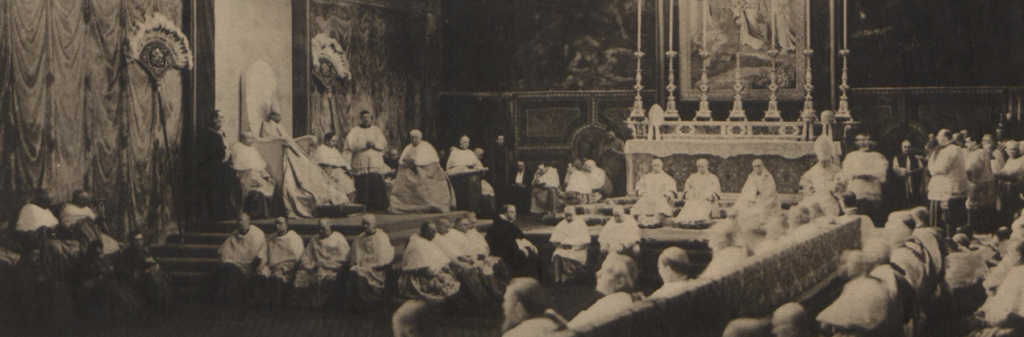
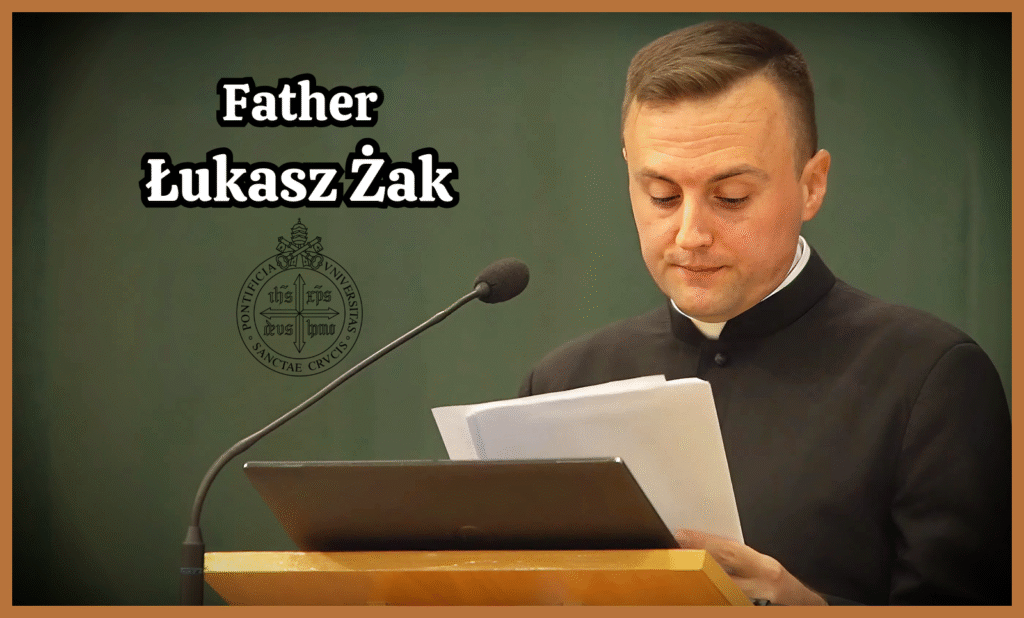
Father Łukasz Żak was born in 1983 in Warsaw, where he studied philosophy, history, and theology from 2002 to 2011. He was ordained a priest in 2011 for the Warsaw-Praga Diocese. In 2022, he defended his doctorate in history at the Pontifical University of the Holy Cross, where he has been teaching since 2024. His duties include director of the Major Seminary Library in the Warsaw-Praga Diocese and editor-in-chief of the academic journal Roczniki Teologiczne Warszawsko – Praskie. [See full CV: click here!].
Caeremoniale Romanum: What was your path to working at the Pontifical University of the Holy Cross?
Father Łukasz Żak: In 2011, I was ordained a priest in the Warsaw-Praga diocese by Archbishop Henryk Hoser. At that time, I had completed three years of history studies at the University of Warsaw. Exactly one month after my ordination, I defended my bachelor’s thesis. The Archbishop then assigned me to pastoral work at St. Brother Albert’s Parish in Warsaw (Wesoła district), where I served as vicar for five years. Although I did not engage in academic work during this time – I devoted myself entirely to parish duties – I did not lose touch with history. At one point, the principal of the middle school where I worked, aware of my historical education, offered me the opportunity to teach history in a bilingual class. This meant that some classes were conducted in English. It was a very interesting and inspiring assignment, allowing me to partially refresh the knowledge I had acquired during my studies.
After several years of working in Wesoła, one of my parishioners, to my great surprise, told me that, if the Archbishop agreed, he was willing to fund specialized studies for me in Rome. I admit, even in my wildest dreams, I hadn’t imagined that someone would make me such an offer. Archbishop Hoser wholeheartedly supported this initiative, released me from my duties as a vicar, and allowed me to study in Rome. When asked what I wanted to study (neither the benefactor nor the Archbishop in any way dictated my course of study), I unhesitatingly said that my dream was to continue my studies in history. Thus, in 2016, my Roman adventure began. To this day, I struggle to find the right words to express my gratitude to both my benefactor and Archbishop Hoser.
After two years of studying Church history at the Pontifical University of the Holy Cross (PUSC), I earned a canonical licentiate. This opened up the prospect of doctoral studies. During this time, I contemplated simultaneously completing a master’s degree in „secular” history at the University of Warsaw. I remembered the high standard of study at that university. It seemed to me that the scientific and methodological skills acquired at a state university would harmonize perfectly with the theological sensibilities of a pontifical university. So I began work on my doctorate in Rome while simultaneously completing a two-year master’s degree in Warsaw. Paradoxically, the pandemic proved beneficial for me, as I didn’t have to travel between Poland and Italy, as teaching, as we remember, was conducted online. I managed to achieve both goals. In 2020, I defended my master’s thesis at the University of Warsaw, and in 2022, my doctorate at PUSC.
After a year of doctoral studies, the Department of Church History at the Pontifical University of the Holy Cross in Rome offered me a position at the university. After obtaining the consent of my bishop, Romuald Kamiński, the PUSC hired me first as an assistant, then as a senior assistant (ricercatore), and from 2024 as an assistant professor (professore incaricato).
CR: Where did your interest in the papal liturgy come from?
ŁŻ: From the very beginning of my adventure with history, I was interested in liturgical matters, although they weren’t initially the main focus of my research. During my undergraduate studies, I focused on Marian devotion in the Carolingian period. My thesis, written at the University of Warsaw, analyzed the way the 9th-century monk Paschasius Radbert spoke about emotions. For this purpose, I used a homily he wrote for the nuns of the monastery in Soissons on the occasion of the Feast of the Assumption of the Blessed Virgin Mary. I attempted to prove that the nuns’ feelings on the Marian feast day were meant to imitate the „feelings” of the angels welcoming Mary into heaven. The liturgy in honor of the Assumption was therefore intended to unite the listeners of the homily with the inhabitants of heaven. This fusion of the two worlds was intended to be so powerful and profound that it could be felt on an emotional level.
I continued my research on Carolingian Mariology in Rome. My undergraduate thesis there was devoted to a Mariological treatise written by another 9th-century monk, Ratramnus of Corbie. This time, I sought to prove that the Mariological heresy he was challenging did not actually exist, but was merely a rhetorical device used by the author to conceal his true theological opponent, Paschasius Radbert.
Various readings, however, sparked a growing interest in the period of the so-called Gregorian Reform. I decided to devote my concurrent work to this topic: my master’s thesis at the University of Warsaw and my doctorate at the PUSC. My master’s thesis focused on the reform activity of Anselm, Bishop of Lucca, one of Gregory VII’s closest associates; for my doctoral thesis, I wanted to analyze the use of Marian themes by both sides in the so-called Investiture Controversy.
Of both projects, I completed only the first. My doctorate was devoted to a completely different topic. When I was offered a position at PUSC, they immediately pointed out that the university needed a specialist in the early modern period. Therefore, I had to look for a different topic. The only source from the turn of the 15th and 16th centuries that I was more familiar with was the diary of the papal master of ceremonies, Johannes Burchard. So I began reading it, seeking inspiration for my doctorate. While reading, I quickly realized that 15th-century popes celebrated Mass only a few times a year. This fact intrigued me and I wanted to understand it better. I found the only attempt to explain this phenomenon in the famous work „Sovrano Pontefice” by Italian historian Paolo Prodi, who argued that the infrequent celebration of Mass was a sign of the secularization of the Renaissance papacy. This interpretation seemed highly anachronistic, so I began to investigate further. The topic became so fascinating that I decided to devote my doctorate to it.
CR: Your research to date has covered many aspects of the papal liturgy – the burial pillow, the Eucharistic cult, the diaries of the masters of ceremonies, and the Ordo Romanus I. Is there anything that connects all these issues, or was their selection rather accidental?
ŁŻ: Papal liturgy in the late Middle Ages and early modern period didn’t emerge out of thin air. It was largely a continuation of earlier customs and traditions. Although the primary source base for my research consisted of texts written at the turn of the 15th and 16th centuries, I constantly had to read sources from earlier eras. This was also because papal masters of ceremonies in the period I was interested in read them. They were intimately familiar with liturgical commentaries written three hundred years earlier, for example. Therefore, I am convinced that a historian of papal ceremonial must have a very broad perspective. When studying this subject, one cannot limit oneself to a single era or a single topic.
Moreover, reading both the sources and studies quickly made me realize that although papal liturgy has been the subject of research for many years, perhaps even centuries (if we consider Jean Mabillion’s research, for example), many issues still remain unexplored. This was the case with Eucharistic worship at the court of the Renaissance popes, which I addressed as part of my doctoral thesis.
I also noticed that not all the interpretations I found in studies seemed convincing. I felt the need to reconsider certain issues, such as the papal burial pillow mentioned in the question. Also, such well-known rites as the opening of the holy door, in my opinion, concealed secrets still undiscovered by historians. The questions that arose within me stimulated me to conduct more thorough research. I have presented some of them in articles, others still require description and more thorough exploration. I feel that the history of papal liturgy is like a bottomless pit; there will always be issues that have not yet been explored or require reconsideration. I anticipate that my findings may one day be challenged. I will not despair about this; quite the contrary. For me, it is far more important that we increasingly understand the fascinating world of papal liturgy than having a monopoly on truth.
CR: Is research on papal liturgy present in Polish scholarship? How is it possible that the first translation of the first Roman Order (Ordo Romanus I) was not published until 2024?
ŁŻ: I have the impression that research not only on papal liturgy, but on medieval liturgy in general, is rarely conducted in Poland. There is a lack of serious projects, and articles often repeat the findings of foreign historiography. This doesn’t mean, however, that Polish scholars lack initiative. An example of an extremely interesting project is the one coordinated by Paweł Figurski, Assistant Professor at the Polish Academy of Science, „Liturgica Poloniae,” which aims to prepare detailed catalog descriptions of over 100 liturgical codes created until the end of the 13th century. Figurski’s team’s use of the latest technology is noteworthy, providing researchers with very useful tools for working with liturgical manuscripts. It is hoped that one day a similar team will be formed in Poland to carry out a significant project on medieval papal liturgy. Initially, it would be enough for someone to undertake a critical edition of the texts of Paride de Grassi, a papal master of ceremonies from the turn of the 15th and 16th centuries. This would already be a major contribution by Polish scholarship to the study of papal ritual.
CR: Let’s return to the issues related to your research. Why didn’t popes celebrate Mass in the late Middle Ages and the early modern period?
ŁŻ: From the end of the 13th century, popes celebrated Mass in person less and less frequently. Stational liturgies, which concluded with the Eucharist celebrated by the Bishop of Rome, became a thing of the past. Popes preferred to participate in Mass rather than preside over it. By the end of the 15th century, they celebrated only two or three Masses a year.
In my opinion, the key lies in understanding the differences between the rite of Mass celebrated by the Pope and that celebrated in his presence by a cardinal or bishop (coram Summo Pontifice and coram Episcopo). In the latter, the Pope was always dressed in a white alb and red cope, vestments whose colors carried Christological significance. Furthermore, the Pope sat on a throne, a reference to Christ’s royal dignity. During such Masses, the cardinals, during the so-called permanent parts (Kyrie, Gloria, Credo, Sanctus, and Agnus Dei), stood before the papal throne in a semicircle, imitating the 24 apocalyptic elders surrounding the throne of the Lamb. All these elements served to emphasize the Christological nature of the papal office. The Bishop of Rome presented himself as „Vicarius Christi”, Christ’s vicar on earth.
Emphasizing the special bond of the popes with Christ in the late Middle Ages was all the more important because papal authority was being questioned from all sides. Popes, therefore, also had to emphasize, at both symbolic and ritual levels, their special role in the Church, which was founded on their unique relationship with Christ. Holy Mass, during which the Son of God is present on the altar, offered popes a unique opportunity to manifest the Christological dimension of their mission. In other words, thanks to the „Corpus Christi,” the pope could present himself as „Vicarius Christi”. Hence the title of my book: „Corpus Christi et Vicarius Christi”.
CR: In what respect can we say that the papal liturgy is exemplary?
ŁŻ: Already in the early Middle Ages, papal liturgy was viewed as a model. This is demonstrated by the history of the Ordines Romani, or descriptions of the papal liturgy, which the Franks readily copied. Roman rituals clearly fascinated them, and they were widely adopted in the Carolingian kingdom, naturally adapting them to local customs.
Later, in the Late Middle Ages, missals modeled on papal ones were widely used throughout Europe. By the end of the 15th century, printed books bearing the title Missale secundum consuetudinem Curiae Romanae (i.e., Missal according to the Custom of the Roman Curia) were already found in many places. Therefore, the liturgy celebrated at the papal court was considered exemplary in this period as well.
The post-Tridentine liturgical reform of Pius V introduced the Ordo Missae developed by the Holy See (composed, it should be added, by the Master of Papal Ceremonies, Johannes Burchard) as binding upon the entire Church. Following the Roman liturgy ceased to be a choice and became an obligation.
As for our contemporary times, I think that a dogmatist or a canonist would be much better able to answer the question about the exemplary character of the papal liturgy than a historian.
CR: What topic would you encourage people fascinated by the papal liturgy to take an interest in?
ŁŻ: First of all, I would simply encourage them to read sources, as they often can be suprising. I remember my surprise when, while reading Paride de Grassi’s texts, I discovered that various liturgical debates were taking place in the papal court in his day. For example, Paride was surprised that some priests genuflected after elevating the Eucharistic species. In his opinion, this gesture was completely inconsistent with the text of the recited Roman Canon. In our times, genuflecting during transubstantiation is not surprising. Moreover, many are struck by the nonchalance of celebrants who do not perform this gesture. Another discovery I made was de Grassi’s considerable skepticism towards the custom of joining fingers after the consecration. At one point, he calls it downright superstitious. I could give many more examples of the various surprises I encountered while reading the sources. I think that reading them could inspire many fascinating discoveries. I therefore extend a cordial invitation to all enthusiasts of the papal liturgy: AD FONTES!
SELECTED BIBLIOGRAPHY OF FATHER ŁUKASZ ŻAK
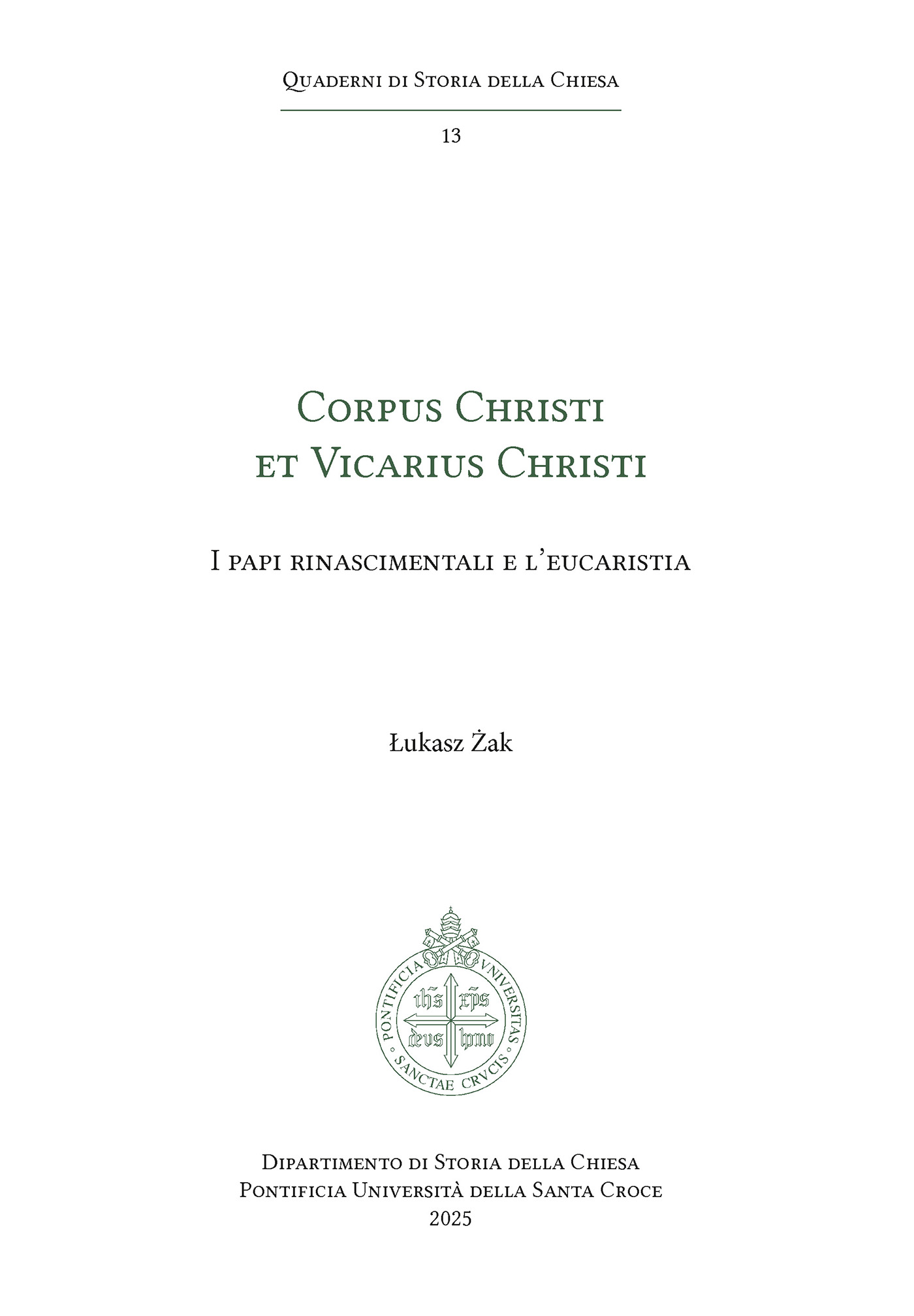 1. Corpus Christi et Vicarius Christi. I papi rinascimentali e l’eucaristia, Roma 2025. 1. Corpus Christi et Vicarius Christi. I papi rinascimentali e l’eucaristia, Roma 2025. | 2. Christological Dimension of Papal Ceremonies: Alexander VI and the Opening of the Holy Door, „Religions” 2025, 16(6), 680. 3. Rzymskie celebracje liturgiczne Jubileuszu 1500 roku, „Poznańskie Studia Teologiczne” 45(2024), p. 115-134. 4. Ordo Romanus I: rito, spazio, persone, w: G. Zaccaria (red.), Ordo Romanus Primus. Introduzioni, Testo latino-italiano, Glossario, Concordanza verbale, Bibliografia, Roma 2024, p. 41-77. 5. Vademecum delle fonti scritte nell’ambito dell’Ufficio delle cerimonie pontificie a cavallo tra il XV e il XVI sec., „Anuario de Historia de la Iglesia”, vol. 32 (2023), p. 375-398. 6. Ordo Romanus I – polskie tumaczenie, „Roczniki Teologiczne Warszawsko-Praskie”, vol. 18 (2023), p. 137-189. 7. Tajemnica papieskiej poduszki. O zapomnianym rytuale średniowiecznej liturgii papieskiej, „Roczniki Teologiczne Warszawsko-Praskie”, vol. 16 (2020), p. 127-142. |
A complete and regularly updated bibliography is available: here!