

Just as peculiar as the work of Msgr. Léon Gromier are the reviews of it, especially those penned by the French prelate’s critics. One such review was published by Louis Bouyer, a Protestant convert to Catholicism, a promoter of the Second Vatican Council, the liturgical movement, and the subsequent liturgical reform, as well as the author of well-known and widely read works on theology and liturgy, such as The Paschal Mystery, Eucharist: Theology and Spirituality of the Eucharistic Prayer, and Architecture and Liturgy. The review appeared in the flagship French journal of the liturgical movement La Maison-Dieu nr 62 (1960/2), pp. 152-153.
Bouyer’s text, intended as a sarcastic and ironic reductio ad absurdum of Gromier’s work and thought, now serves, in light of what has befallen the liturgy and Catholic ceremonial since 1965, as a kind of tribute to the book by this French expert on papal and pontifical liturgy.
Should other reviews or press mentions of Mons. Gromier’s Commentary on the Caeremoniale Episcoporum be discovered, they will also be included and discussed here.
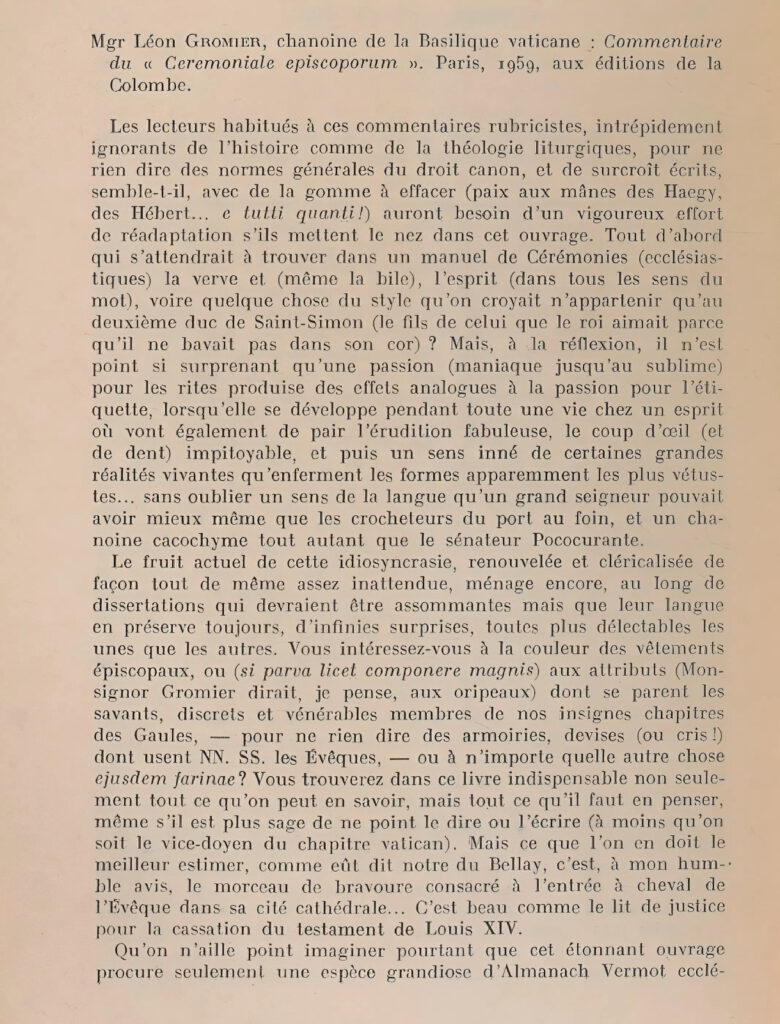
Those accustomed to this type of rubric-focused commentary, blissfully ignorant of both the history and theology of the liturgy, to say nothing of the general norms of canon law, and seemingly written with an eraser in hand (may the souls of Haegy, Hébert, and all the rest rest in peace!), will have to make a considerable effort to adapt to this book.
For who would expect to find, in a manual on church ceremonies, such verve – even such bile – such wit (in every sense of the word), or indeed a style that one might have thought reserved exclusively for the other Duke de Saint-Simon? And yet, upon reflection, it is perhaps not so surprising that a passion for ritual, at once nearly maniacal and truly sublime, should yield results akin to a passion for court etiquette, provided it unfolds over a lifetime within a mind that combines extraordinary erudition, a pitiless gaze – and an equally pitiless tongue – with an innate grasp of the grand, living realities concealed within even the most archaic-seeming forms. Add to this a command of language that a great nobleman might envy, and which a canon in failing health could wield just as effectively as a Senator Pococurante.
The fruit of this peculiar personality, renewed and, quite unexpectedly, clad in clerical robes, offers, amidst reflections that ought to be tedious but, thanks to the author’s language, never are, countless surprises, each more delightful than the last.
Is anyone interested in the color of episcopal vestments? Or perhaps, if one may compare small things with great, in the insignia of rank (Monsignor Gromier would likely call them „baubles”) with which the learned, discreet, and venerable members of distinguished French chapters adorn themselves? Or, for that matter, the coats of arms, mottos, and battle cries employed by the most venerable bishops? In this indispensable volume, one will find not only everything there is to know on the subject, but also everything one ought to think about it—even if, in truth, it might be wiser neither to speak nor to write of such things, unless, of course, one happens to be the vice-dean of the Vatican chapter.
However, I consider the best part of the work to be, as our Du Bellay might put it, a showpiece passage describing the bishop’s entry into his cathedral city on horseback. It is as beautiful as a session of the royal court convened to annul the will of Louis XIV.
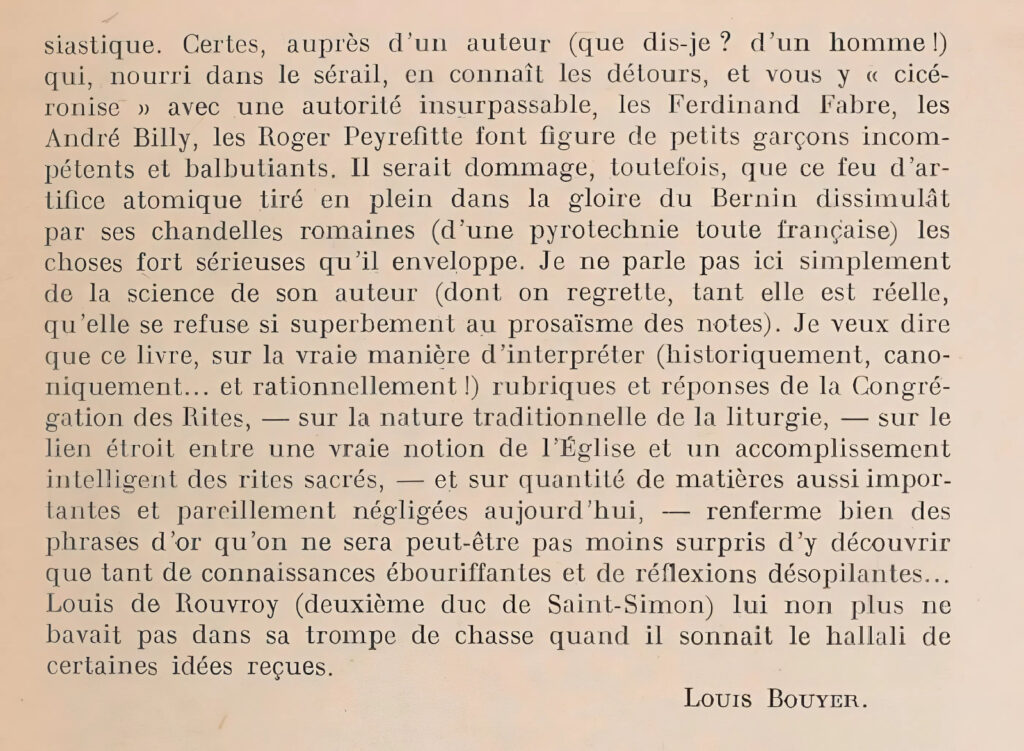
One should not, however, imagine that this extraordinary work is merely some monumental, ecclesiastical equivalent of an almanac filled with curiosities. Indeed, when compared to the author, a man raised in the very heart of this world, who knows every one of its nooks and crannies and guides one through them with unparalleled authority – Ferdinand Fabre, André Billy, and Roger Peyrefitte appear like clumsy schoolboys, barely able to stammer out a few words.
It would be a pity, however, if this atomic firework, ignited amidst the full radiance of Bernini’s glory, with its Roman pyrotechnics staged in a distinctly French manner, were to obscure the very serious matters it conceals. I am not referring merely to the author’s erudition, the authenticity of which is so profound that one might regret his haughty refusal to grant it the mundane form of footnotes.
My point is that this book contains many truly invaluable insights. They concern the proper way to interpret the rubrics and the responses of the Congregation of Rites, viewed from historical, canonical, and rational perspectives, as well as the traditional character of the liturgy, the intimate connection between a true understanding of the Church and the intelligent celebration of sacred rites, and numerous other issues that are equally important, yet similarly neglected today.
It may come as no less of a surprise, alongside the author’s vast erudition and disarmingly amusing reflections, to discover just how many valuable insights this book contains. Louis de Rouvroy, the second Duke of Saint-Simon, was certainly not just blowing his own hunting horn thoughtlessly when he proclaimed his triumph over certain well-established, conventional views.
Louis Bouyer