

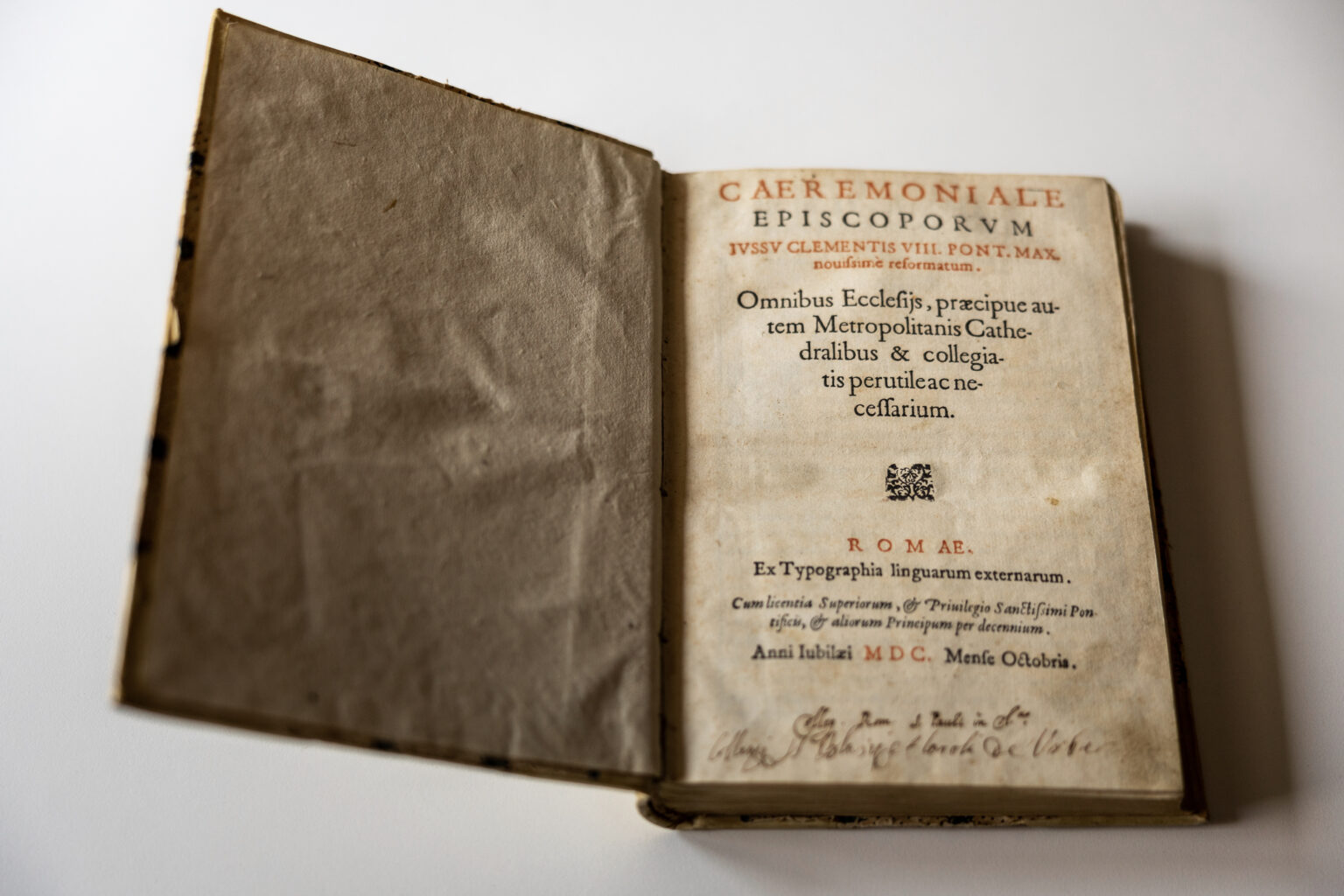
The Caeremoniale Episcoporum appeared during the pontificate of Clement VIII, promulgated by the brief Cum novissime on July 14, 1600. It was a new book, one that had never existed before, though the wording of the brief might suggest otherwise. In its early editions, the title even claims that the work had been „newly reformed” rather than newly composed. It is new more in terms of form than content, representing a combination of three elements, which will be presented shortly. Its compilation took seventeen years.
In December 1582, Gregory XIII entrusted this task to two cardinals then residing in Rome: Saint Charles Borromeo, Archbishop of Milan (d. 1584), and Gabriele Paleotti, Archbishop of Bologna (d. 1597). The former had been involved in the matter for several years and was the primary advocate for this decision. An editorial team was established, consisting of the following members: Luigi De Torres, a Roman, referendary of both Signatures, and canon of the Basilica of Saint Mary Major (who died as a cardinal in 1609); Agostino Fivizzani, a Roman, an Augustinian friar, and papal sacristan (d. 1595); Francesco Mucanzio, a Roman and papal master of ceremonies (d. 1592); Curzio De Franchi, a Roman, a beneficiary and later a canon of Saint Peter’s Basilica (d. 1591); and Pietro Galesini, who had served Saint Charles Borromeo in both Rome and Milan, but returned to Rome when Saint Charles went back to Milan, who acted as his representative in the editorial work and died around 1590. In addition to these five individuals, Giovanni Paolo Clerici, a master of ceremonies at the Cathedral of Milan, may have exerted some influence from Milan, particularly during the lifetime of Saint Charles. Upon his return to Bologna, Cardinal Paleotti was replaced by the curial cardinal Antonio Caraffa (d. 1591). The Sacred Congregation of Rites, established by Sixtus V in 1587, certainly took on the task of replacing those who had died and completing the work, right up until its publication.
In preparing the Caeremoniale Episcoporum, the intention was to achieve three objectives:
- to make use of ceremonial additions that had been removed from the official Pontificale which was due to be published in 1596;
- to adapt for bishops, cathedrals, and collegiate churches the Caeremoniale Sanctae Romanae Ecclesiae [Ceremonial of the Holy Roman Church], which was drawn up for the Pope and the papal chapel;
- to create a ceremonial manual, similar to the one written by Paride (in French: Paris) Grassi at the beginning of the 16th century, intended for bishops, chapters, and monasteries, and designed more for the purpose of instruction than for the direct performance of rites. The goal was a book for study, containing no prayer texts.
For this purpose, three identified elements were used:
- a) general principles and descriptions contained in the appendices to numerous private pontificals that preceded the pontifical of Clement VIII;
- b) The Caeremoniale Sanctae Romanae Ecclesiae, written by two papal masters of ceremonies, Agostino Patrizi and the Alsatian Jean Burckard, was completed in 1488, though it was not published until 1516 by Cristoforo Marcello under the title Sacrarum caeremoniarum sive rituum ecclesiasticorum Sanctae Romanae Ecclesiae libri tres. This work, enriched by the notes and diaries of earlier papal masters of ceremonies, serves as a continuation of the final Ordines Romani; it was frequently reprinted up until 1750 and forms the foundation for the Caeremoniale Episcoporum.
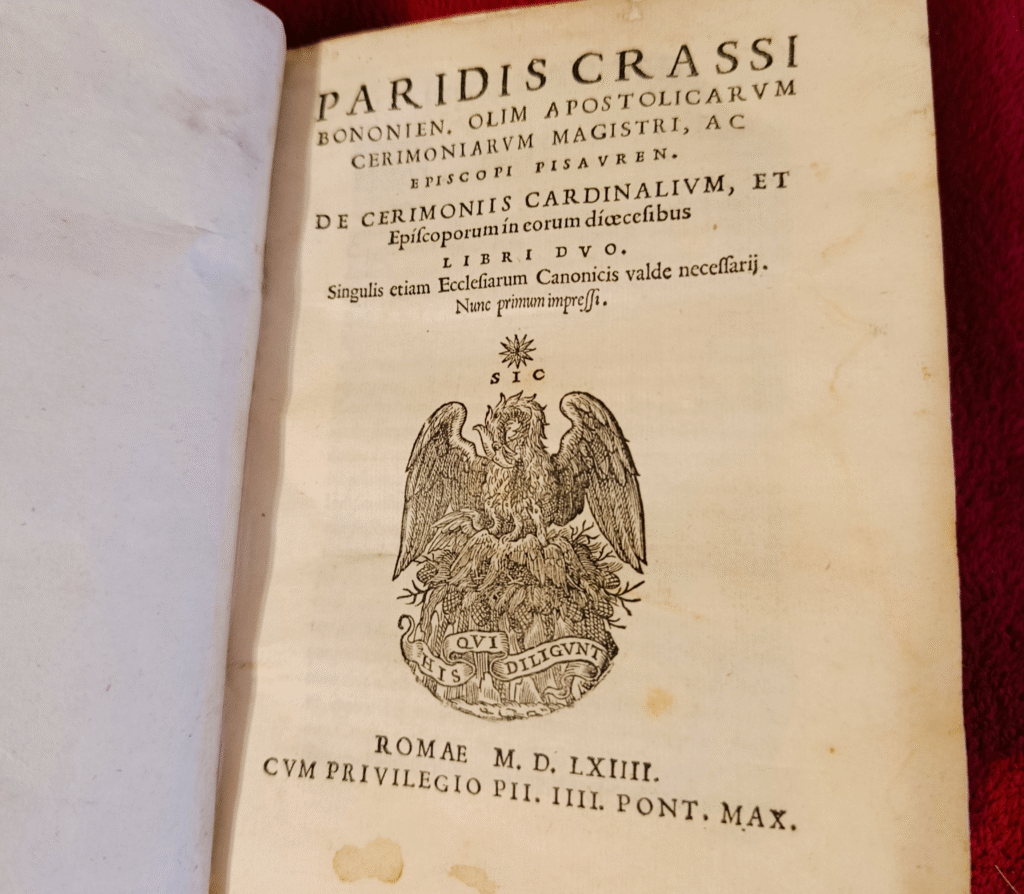
- c) a book written at the beginning of the 16th century by P. Grassi, a canon of Bologna and former papal master of ceremonies, which was not published until 1564, by Francesco Mucanzio, under the title De caeremoniis cardinalium et episcoporum in eorum dioecesibus libri duo. It provided the blueprint and, to a large extent, the arrangement of the chapters for the Caeremoniale Episcoporum, which incorporated numerous significant passages from it.

Has the objective intended in the drafting of the Caeremoniale Episcoporum, which I shall henceforth refer to by the initials C.E., been achieved? In general, yes. One can be satisfied with the final result, especially when one discovers the eccentricities that individual editors sometimes introduced. Ultimately, the work presents the teaching of the Caeremoniale Sanctae Romanae Ecclesiae well, with reasonable adaptations concerning bishops. At times, however, these adaptations could have been better executed; certain decisions should have been more soundly justified; one would have liked to see greater decisiveness and less ambiguity.
As for the editing of the C.E., it is rather mediocre and leaves much to be desired. The division into chapters is primitive. In the earliest editions, chapter titles appeared at the beginning of each chapter. Later, in 1729, these titles were relocated to form a table of contents; in their place, the chapters were given summaries, summaries that do not always accurately reflect the content. The subdivision of chapters into numbered paragraphs, also introduced in 1729, often appears entirely arbitrary. Parts of sentences have been rearranged, to the significant detriment of their meaning. The punctuation is highly flawed. Frequently, two separate sentences are joined into one, even when the first is conditional, which misleads the reader into looking for a subordinate clause that does not actually exist. There is a recurring use of phrases such as „One may do this…,” „One should…,” or „If possible, or if it can be done easily….” In other words, advice and prescription, suggestion and command, are presented as if they carry equal weight. Yet, the C.E. was written not to address what might be done, but what must be done; it concerns not mere propriety or convenience, but fundamental principles. Among other stylistic flaws and improprieties, the verbs „to read,” „to recite,” „to speak,” and „to sing” are used indiscriminately.
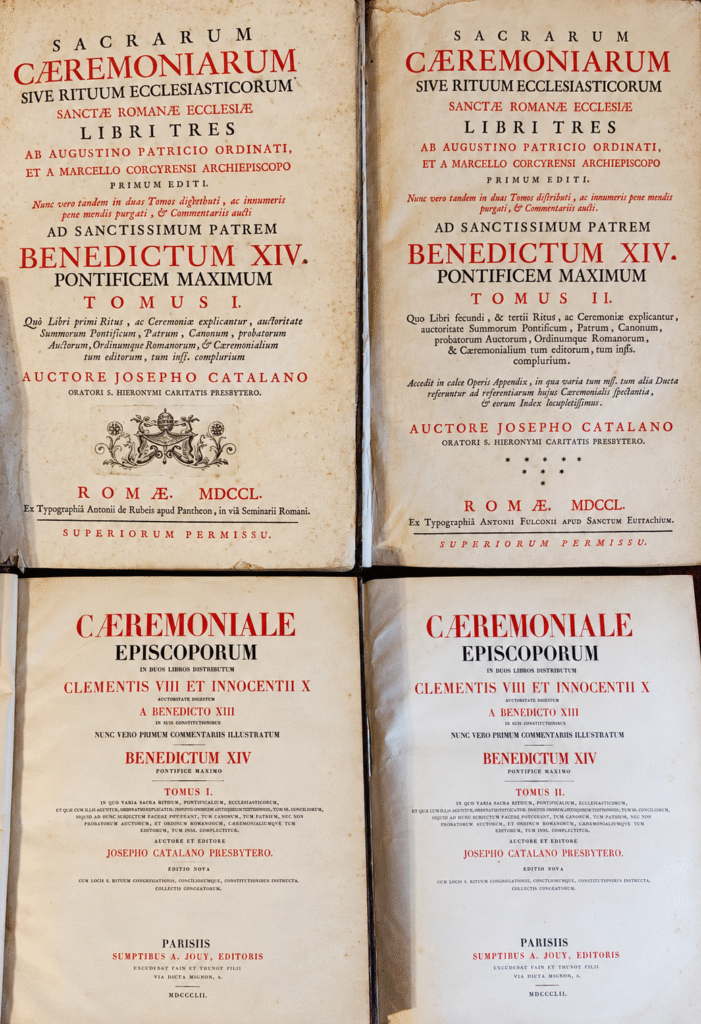
The C.E. stands in need of a commentary. To date, three individuals have recognized this and attempted the task. The first was the Oratorian Giuseppe Catalani, who published Caeremoniale Episcoporum nunc primum commentariis illustratum (two folio volumes, Rome 1744). One might say that he circles the subject without ever truly delving into it; rarely does one find the desired explanation or an answer to the questions that naturally arise. Instead of commenting on the text of the C.E., the author dwells at length on the particular day or feast, a subject already thoroughly covered by others. He fills his volumes and columns by citing long passages that bear, at best, a tenuous connection to the topic at hand. He imagines he is providing a commentary on a given paragraph by repeating its content word for word, appending a remark of his own, often characterized by fabrication or digression, only to conclude by asserting that the matter is too self-evident to require any explanation. A reissue of this work, published in Paris in 1850 to support the purported adoption of the Roman Rite in France, included a few additional notes, but these did nothing to improve the original.
Secondly, there is Le Cérémonial des évêques commenté et expliqué (in-8°, Paris 1856), authored by Msgr. Ignace Bourget, Bishop of Montreal, Canada. It is a collection of notes regarding what the author observed and learned during his stay in Rome on the occasion of the proclamation of the dogma of the Immaculate Conception. The author’s devotion and zeal could not compensate for the lack of preparation and experience from which he suffered.
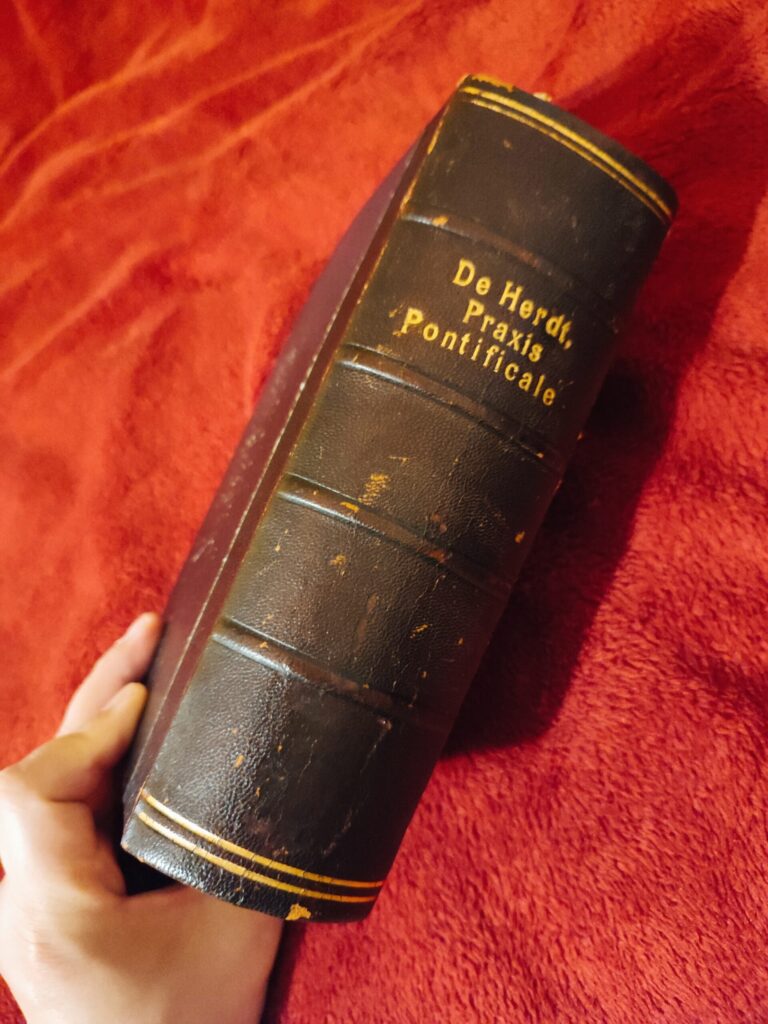
Thirdly, there is Praxis pontificalium seu Caeremonialia episcoporum practica expositio (3 volumes, octavo, Louvain 1873), by P. J. B. De Herdt, a canon of the Archdiocese of Mechelen. The work approaches the nature of a commentary, as it closely follows and quotes the text of the C.E.; yet, it falls short of being a true commentary, as it lacks extensive or in-depth discussion. It functions more like a concordance between the Caeremoniale Episcoporum and the decrees of the Sacred Congregation of Rites. It presents a vast number of decrees, which are not always relevant to the subject at hand, nor always consistent with one another. Proceeding from the assumption that both the Caeremoniale Episcoporum and the decrees are infallible, the author labors to reconcile them, often arriving at tenuous or fanciful conclusions. Placing greater trust in the letter than in the spirit, and lacking the boldness to state anything not already articulated by others, he occasionally attempts to interpret the Caeremoniale Episcoporum by invoking the Caeremoniale Sanctae Romanae Ecclesiae, a text he does not actually understand.
The shortcomings of earlier commentaries prompt me to present the C.E. in a better light: by providing explanations that reveal its underlying line of thought; by making the described ceremonies easier to understand; and by rendering the execution of its prescriptions both simpler and more engaging. A commentary in French requires a French translation of the Latin text, a text that is notable neither for its internal clarity nor for the logical order of its exposition.
Like the Latin text, my commentary cannot account for the origin, development, or cause of the ceremony. I provide justification for anything that might appear to be an overly free translation of C.E. I flesh out what C.E. intended to convey but left unsaid. I correct obvious errors, impose order where it is lacking, and remove words that are superfluous, detrimental, inappropriate, or inaccurate. I supply what is necessary for the integrity of the text or the development of the argument. I restore the true relationship between cause and effect wherever it has been distorted. Any words, phrases, or entire sentences that I have added are enclosed in brackets. I am dealing with matters with which I am well acquainted, and I assure the reader that I am not taking advantage of their credulity. I present my views without any scholarly apparatus, leaving it to someone more learned than myself to undertake the task of refuting what I have said.
In response to the questions I have been asked, I explain the existence of the episcopate in one situation or another.
Authors with a penchant for canon law or moral theology have not failed to debate whether there exists an obligation to observe the Caeremoniale Episcoporum (C.E.). Without wishing to disrupt their discussions, I would suggest that the observance of these ceremonies is a matter of understanding and formation far more than it is a matter of conscience. Anyone who truly understands the Caeremoniale Episcoporum will do everything in their power to follow it. Others (and how many there are!) will perform ceremonies they do not comprehend, in a manner that reflects their own lack of understanding. This is all the more significant given that the Caeremoniale Episcoporum concerns not only bishops, but also cathedral, collegiate, and monastic churches; indeed, any place where solemn liturgical rites are celebrated; it serves as an essential complement to the Missal and remains the only existing collection of regulations governing the celebration of the Divine Office.
I am commenting on the C.E. based on the 1886 edition from Pustet of Regensburg, the final edition to be designated as „typical.” Appended to the decree of authenticity, the publisher included an opinion by the Redemptorist G. Schobert, one of the compilers of the last, eclectic, and incomplete collection of decrees from the Sacred Congregation of Rites, which was completed in 1900. This religious friar attests that every page of the C.E. was reviewed, corrected, and approved prior to printing; though, naturally, only to the extent that the proofreader remained attentive.
The Caeremoniale Sanctae Romanae Ecclesiae – from which the C.E. is partly derived – frequently refers to the „Papal Chapel,” for which it was originally written. The Annuaire Pontifical (Papal Yearbook), which for forty-one years served as a valued resource for the clergy, defined it as follows: „The Papal Chapel comprises all persons and colleges that hold an assigned place within the Papal Chapel and are, by virtue of this, required to accompany the Pope during his public functions, consistories, chapel services, and processions.” I shall attempt to provide a more satisfactory definition, pending a better one. The Papal Chapel is an assembly, consisting of the Sacred College, the episcopate, the prelature, the Papal Household, and various ecclesiastical, religious, and lay officials and dignitaries, gathered for solemn liturgical functions presided over or attended by the Pope (even if such functions take place during his temporary absence, or during a sede vacante). It also convenes for public consistories, though these are not liturgical acts; historically, it also assembled during the procession for the taking possession of the Basilica of St. John Lateran by a new Pope. Thus, it is evident that the term „Papal Chapel” denotes, first, a physical space; second, the events that take place within it; and third, the individuals who participate in those events.

Since the C.E. also refers to prelates who are not bishops, it is appropriate to define the terms „prelate” and „prelature.” Assuming that the cardinalate is not a prelature, but rather a higher status, an ecclesiastical principality, a prelature may be understood as an ecclesiastical dignity of varying degrees, granted by or at least approved by the Pope. It is held for the lifetime of the incumbent, carries universal recognition (with certain exceptions in the Papal Chapel), and entails specific insignia and precedence. A prelature is rooted in an office, though it is often merely honorary.
The discussion will concern the Pope’s familiantes (members of his household) in the context of the order of precedence; it is therefore necessary to provide a precise definition. The papal household, or familia, denotes the entire body of individuals of all ranks: clergy, members of religious orders, and laypeople, who constitute the customary entourage of the reigning Pope, whether in an active or an honorary capacity.
These matters cannot be fully clarified, as in religious literature a cardinal is often referred to as a more prominent prelate, while one may read that a bishop has been elevated to the dignity of a prince of the Church.
When referring to the papal chapel, I use the present tense, though it should be understood in the past tense. Until September 20, 1870, the papal chapel functioned fifty-eight times a year, not counting additional events; since that date, it has ceased to be part of the liturgical cycle, both the liturgical seasons and the feasts of the saints. Now, one sees only canonizations, the occasional anniversary Mass, or events related to a change in the pontificate. A vast and regrettable void! In the papal chapel, bishops once had a magnificent example of liturgical zeal. Deprived of this stimulus, some now leave their cathedrals even on major feast days, traveling to various towns within their dioceses to attend religious, social, educational, agricultural, or sporting gatherings, often followed by a reception at the town hall, if possible. It even happens that liturgical offices, which ought to be celebrated in the cathedral, are instead held in the chapel of the major seminary. One also encounters troubling irregularities, such as the case of an archbishop who, on November 2nd, chose to celebrate a low Mass at a cemetery rather than participate in the commemoration of the faithful departed at his own cathedral.
In accordance with the C.E. , I use the term „pluvial” to refer to the silk mantle known to everyone; by „cappa,” I mean a choir vestment which, in various forms, is, or has been, worn by cardinals, bishops, metropolitans, nuncios, the collegiate prelates of the Roman Curia, cathedral and collegiate chapters, canons regular, many secular chapters, and several mendicant orders. There is no need to employ the Latin or Italian term cappa. The qualifier magna, often attached to the term, can only refer to the cappa worn by cardinals and prelates (as well as by members of certain chapters), which, during the Renaissance, was extended by the addition of a train. Any cappa, whether it lacks a train or has its train tucked up, remains a cappa.
The liturgical expressions „to put on,” „to be clothed in,” and „attire” refer to the act of donning sacred vestments, the individuals who are dressed in them, and the state of the person wearing them.
I consider it useful to provide commentary on the third book of the C.E., even though it is an addendum justified by a bygone era. This book not only sets forth specific ceremonial rules but also fosters respect for hierarchy, proper order, and protocol; it stands against careless informality and a supposedly democratic familiarity. If the spirit of this third book were to prevail, we would not see a diocesan archbishop going to a railway station to await and welcome a titular archbishop arriving to serve as his coadjutor; nor would we see a diocesan bishop, accompanied by his chapter, standing at the doors of his cathedral to receive a titular bishop arriving to serve as his assistant.
My work, unfashionable and begun in 1950, would have appeared nearly two years earlier, had it not been delayed by petty and unpleasant chicanery.
Proponents of the new school, who steer the liturgical movement, view the C.E. merely as a book of spells, an antiquated relic, or a chessboard upon which the pieces can be moved about at will; they have no grasp of the doctrine it contains. The Caeremoniale Episcoporum originates from an era when pastoral care adapted itself to the liturgy, and when pastors had no intention of dictating the course of ceremonies. The memory of those times deserves to be preserved, and thus, to have a witness. Should the question of revising the C.E. ever arise, it will be necessary, rather than allowing it to be ruined, to find individuals for the task other than those whom the present age has thus far produced.
In the table of contents, the chapter titles have been made, where necessary, more consistent with their actual content than they were in the Latin versions.
L[éon]. G[romier].
Rome, January 15, 1959